
While boring food – hay and some pellets – are the basis of rabbits’ daily diet, these animals will also enjoy some variety and challenge. Providing food enrichment for rabbits is not difficult.
Just a bit of extras
In spring and summer, enriching their diet is especially simple. You don’t need to buy anything, a couple of leaves or fruits from a garden or a meadow are nice daily additions. Think for example, of leaves and fruits of raspberry, strawberry or blueberry. You rabbits will also enjoy some common weeds: leaves and flowers of dandelions, ground elder leaves, plantains or dried stinging nettles. If you don’t have access to a garden or a meadow, use some herbs, like basil, parsley leaves, mint or coriander.
A daily handful or two of freshly cut grass (by hand, not by mowing machine) it’s also a nice addition to rabbits’ diet. Like hay, it’s good for keeping their teeth short and their digestive system healthy.
Just a bit of challenge
Adding some fresh plants provides enrichment to rabbits’ lives in the form of new smells and tastes. But it can easily be turned into some cognitive and behavioural enrichment. In the wild, rabbits spend most of their day looking for and eating food. In our homes and enclosures, we provide for them. However, making foraging more interesting than just eating from a bowl will keep your rabbit busy, can prevent behavioural problems and increase animals’ well-being.
And it doesn’t have to be complicated on your side. Some tips include:
– hide the fresh leaves in the hay pile/rack
– make a hay “ball” – wrap some fruits and/or fresh leaves in a handful of hay and stick them in a cardboard toilet/kitchen paper roll.
– throw a handful of pellets/fresh leaves/fruit pieces in the run for rabbits to look for them
You can also invest a bit and buy a metal wire ball (see photo) and fill it with grass or hay mixed with fresh leaves and hang it on the wall of the cage/run – rabbits will need more time to get to the food. One of my rabbits also likes a food ball – I put some pellets inside it and she pushes it around with her nose for food to fall out (but if you see that your rabbit nibbles at the ball, take it away).
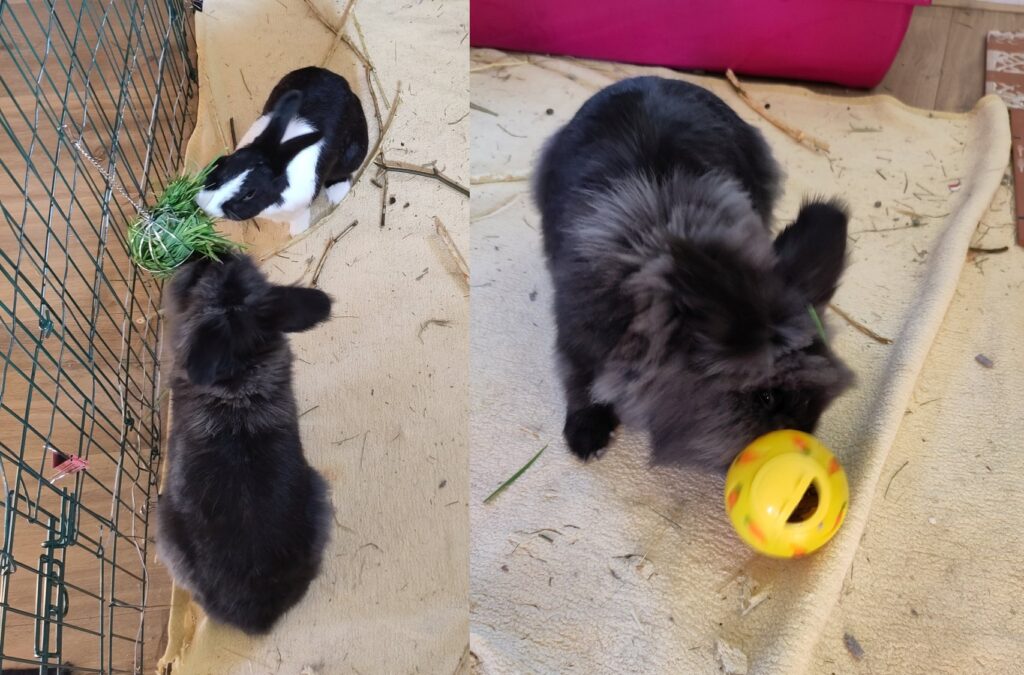
And don’t forget to regularly provide some branches for your rabbit to chew on. It will not only give them something to do but will also help keep their ever-growing incisors short and will help satisfy their inner need for chewing. Willow, apple or pear tree branches are my rabbits’s favourites.
Just a bit of caution
Rabbits’ digestive system is sensitive to diet changes, so introduce new food slowly – a couple of more leaves, fruit pieces, small handfuls of grass or a short stick per day.
Never collect grass and herbs from places where wild rabbits live to avoid diseases.
Avoid collecting grass and herbs from places where other animals do their business. If you are not sure, wash the food.
Don’t collect food next to a road or from trees that were sprayed with insecticides
Be careful with fruits – they are sweet and should be just a very small part of the rabbits’ diet – a couple of small pieces per day is enough.
Just a few examples
A (non-exhaustive) list of common plants rabbits can eat: strawberry (leaves, flowers, and fruits), apple tree (branches, leaves, fruits, and flowers), blackberry (leaves, branches, fruits, and flowers), thistle (leaves, stems, and flowers), raspberry (leaves, branches, fruits, and flowers), clover (leaves and flowers), mint (leaves and flowers), dandelion (leaves), pear tree (branches, leaves, fruits, and flowers), thyme (leaves and flowers), violets (leaves, stems, and flowers), plantain (leaves and flowers), willow (branches and leaves), carrot (leaves rather than roots), ground elder (leaves and flowers), sorrel (leaves).
If you want more tips concering enrichment for rabbits or rabbit behaviour, don’t hesitate to contact me.